
Assessment
‘Learn Different means Assess Different’ — assessment at Imperial Oak is designed around each learner’s profile, prioritising meaningful progress over comparison.
‘At Imperial Oak School, each learner possesses a unique profile and set of needs that require a tailored approach to learning and, consequently, assessment. Four key elements define our assessment process at Imperial Oak School.’
‘Learn Different means Assess Different’ (Imray, 2024)
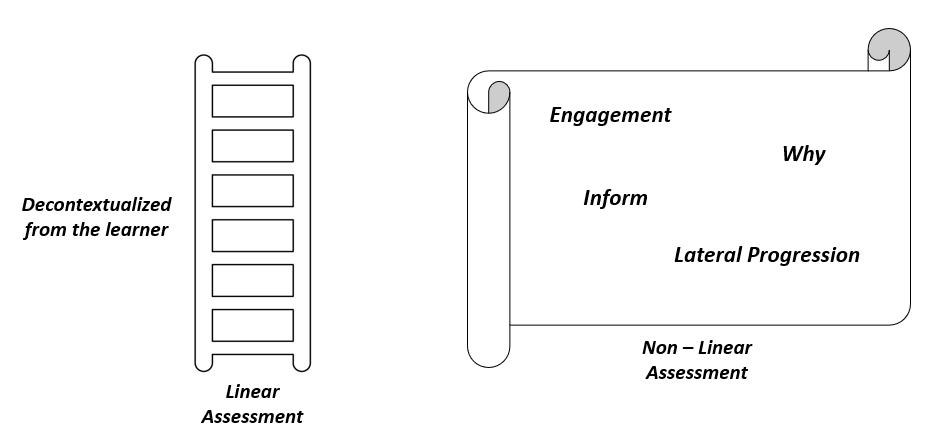
Linear VS Non-Linear Assessments
According to recent research findings (Sissons, 2024), there are widely recognised difficulties associated with linear assessments and learners with Severe Learning Difficulties and Autism.
Imperial Oak School uses a wide variety of non-linear assessment frameworks specifically designed to overcome the difficulties of linear assessments in learners with SLD, CLD and/or Autism.
Linear frameworks often disconnect learning from the learner’s context, rendering the learner a passive participant in the educational process.
This approach tends to emphasize the learner’s limitations rather than their abilities, hindering independence and the ability to generalize skills (Sissons, 2024).
Ipsative Assessment
All learners at Imperial Oak School are different and unique and, therefore, require an approach to teaching and planning which renders meaningless any kind of comparative judgements or benchmarking (Sissons, M. 2024).
At Imperial Oak School, our focus is on ipsative assessment, which measures an individual’s progress in relation to their own prior learning. This approach prioritises personal growth over comparisons to year-level expectations or the performance of other students.
Pupils are ipsatively assessed termly based on a range of factors unique to them. Each learner has a Personalised Learning Plan where the starting point in writing personal learning intentions is the learner’s motivations, strengths and needs.
Assessment of Lateral Progress (ALP)
Lateral progress (as opposed to linear) focuses on qualitative aspects of a skill — Sissons, 2024
Independence
Refers to the level of prompting or cueing which a learner needs to perform a task.
Fluency
Refers to the confidence and accuracy with which a task is performed.
Maintenance
Refers to the consistency of performance over time.
Generalisation
Refers to the ability to transfer a skill to novel contexts, including people, material and setting.
Recording System
Evidence for Learning is used for evidencing and tracking progress against individual Personalised Learning Plans targets related to Cognition and Learning, Communication and Interaction, Personal, Social, Emotional and Mental Health and Physical and Sensory Development.
These are linked to pupils’ aspirations as set out in their Education Health & Care (EHC) Plans.


‘Academic Performance’ 2025 – 2026
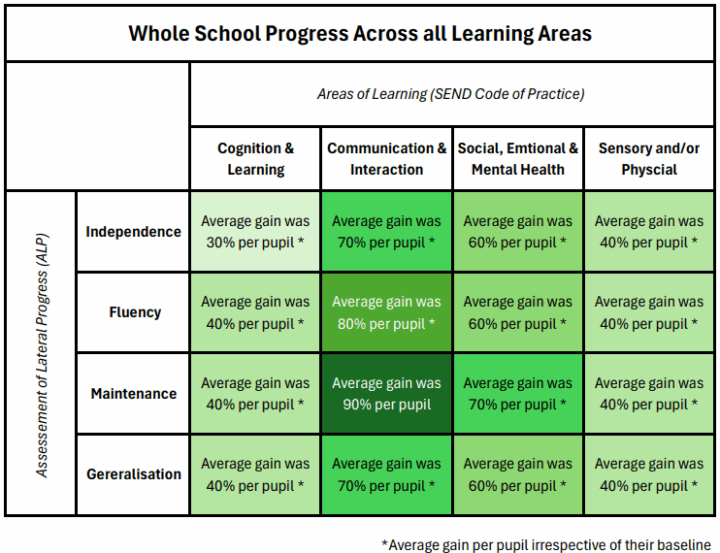
While Imperial Oak School focuses on Ipsative Assessment, as required by the current Independent School Standards (DfE, 2019 – Part 6, Section 73 (e)), we also publish ‘academic’ ‘performance’ results.
This heatmap shows the whole-school average attainment across the SEND Code of Practice areas for the four lateral progress domains:
- Rows: Independence, Fluency, Maintenance, Generalisation
- Columns: Cognition & Learning; Communication & Interaction; Social, Emotional & Mental Health; Sensory and/or Physical
- Cells: average score (1–10), providing a clear view of strengths and relative gaps.